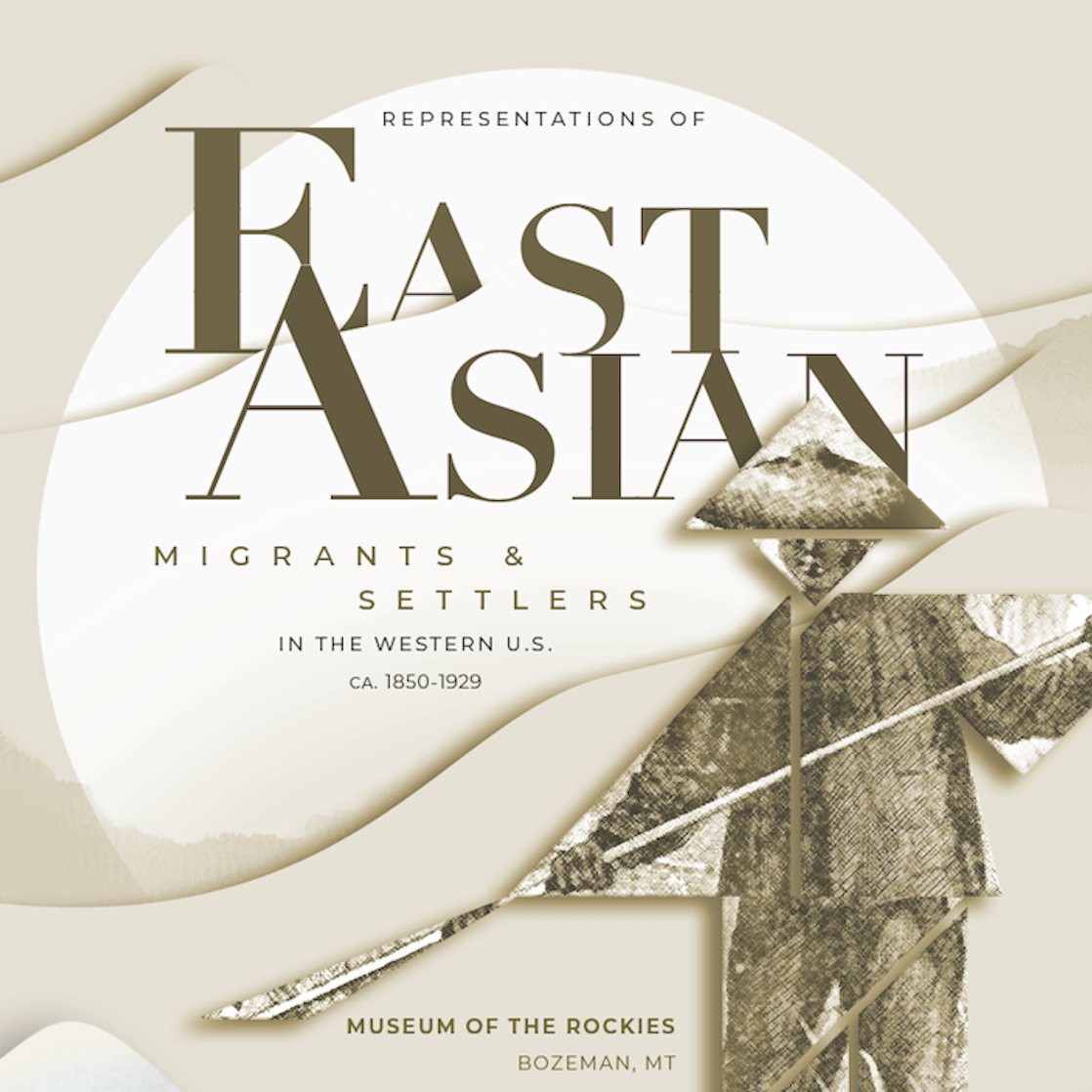
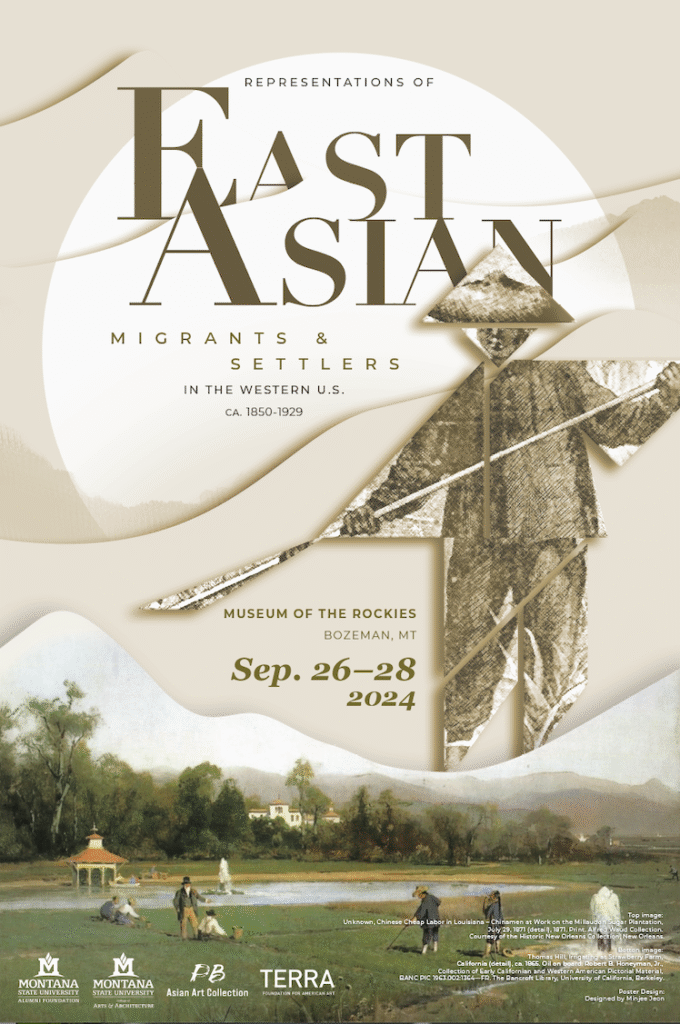
Minjee Jeon, Poster for the Representations of East Asian Migrants and Settlers conference, 2024
This conference on the theme of Representations of East Asian Migrants and Settlers in the Western United States ca. 1850-1929, co-organized by Professor Todd Larkin (Art History) and Professor Hua Li (Chinese Language), was held in the Hager Auditorium at the Museum of the Rockies, Montana State University, Bozeman, on 26-28 September 2024. The program described the aims of the conference as follows.
This event provides scholars from universities, museums, libraries, and archives an opportunity to exchange research on the ways Asian American and Euro-American artists represented Asian migrants and settlers in art between the Gold Rush and the Great Depression. Over the last thirty years, historians have probed Asian American migrants’ experiences of work, settlement, and discrimination in the mining and railroad towns of the West while art historians have explored Asian American artists’ production of original works rooted in transnational dialogues, aesthetic choices, and social experiences on the East and West Coasts. This conference builds on these scholarly trends by ascertaining how Asian and European artists who journeyed through or resided in the American West between 1850 and 1929 contributed to a rich array of representations of Asian sojourners and settlers in different genres—documentary, picturesque, academic, expressive, illustrative, satirical—that promoted a range of views—ethnographic, nationalistic, empathetic, propagandistic, associational, filial, ethnic, gendered. A range of papers illuminate not only how Euro-American artists imposed naturalized, stereotyped, racist, and other identities but also how Asian American artists and individuals deflected, contested, or rejected such images in the construction of their own identities.
In the first half of the conference, “Daily Life in the West,” presenters will discuss images of Asian migrants and immigrants in contexts of labor, leisure, worship, and celebration; in the second half of the conference, “Contested Claims,” presenters will discuss representations of Asians in contexts of association, discrimination, and exclusion as well as visual strategies Asian Americans employed to negotiate hostile surroundings and to construct independent identities. In the last session, contemporary Asian American artists will share how they have engaged with, referenced, or distanced the past in their art.
PART ONE: DAILY LIFE IN THE WEST
Thursday, 26 September 2024
9:30 – 10:00 am
Conference Welcome and Opening Remarks
Waded Cruzado, President of Montana State University
Dean Adams, Dean of the College of Arts & Architecture
Todd Larkin, Professor of Art History
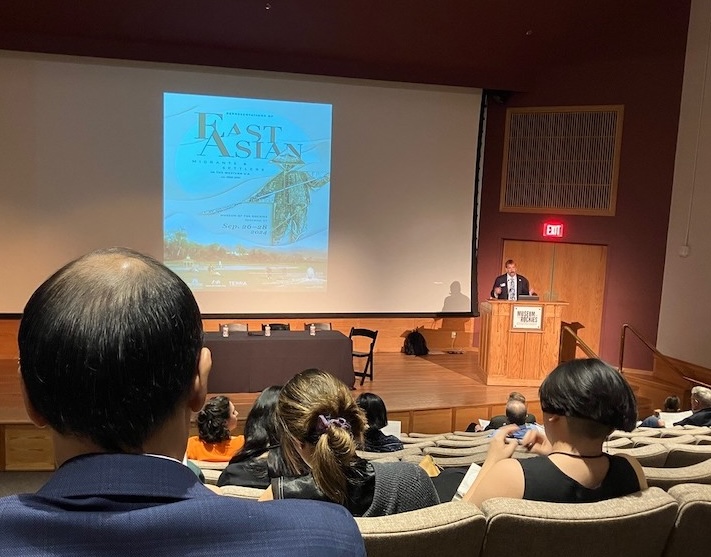
Dean Adams, Dean of the College of Arts & Architecture, delivers opening remarks
10:15 am – 12:15 pm
Session 1. Labor, Part 1: In the Mines, on the Rails, in the Fields, and in the Markets.
Chair: Hua Li, Professor of Modern Languages, Montana State University, Bozeman
Peter Wang, University of Kentucky, “Retracing and Recontextualizing Chinese Labor in the Mines, in the Woods, in the Fields, and on the Rails”
Philip F. Williams, Montana State University, “A Ghost Community: The Emergence and Eventual Disappearance of the Chinese Community in Virginia City”
Hannah Smith and Jake Rivers, Montana State University, “Remembering Early Chinese Immigrants in Montana: A Study of Artifacts in the Mai Wah Museum, Butte”
Olivia Armandroff, University of Southern California, “Photographing Explosions, Both Natural and Not: The Work of Kenichi Maehara and Tai Sing Loo”
12:30 – 2:00 pm
Lunch for conference participants at the Museum of the Rockies downstairs
2:15 – 3:45 pm
Session 2. Labor, Part 2: In the Mines, on the Rails, in the Fields, and in the Markets.
Chair: Edward Tang, Professor of American Studies, University of Alabama, Tuscaloosa
Micah Chang, Montana State University, “From Dekasegi to Permanence: Japanese Sugar Beet Laborers and the Northern Plains, 1893-1924”
Xi Zhang, Scripps College, “Picturing the ‘Other’ in America: Nineteenth-Century Anti-Chinese Advertising and Images of Chinese Laundrymen”
Xiaoquan Raphael Zhang, American University, “Negotiating and (Re)creating Chinese American Identity: A Reinterpretation of Theodore Wore’s Paintings of San Francisco Chinatown”
4:00 – 6:00 pm
Session 3. Leisure: On the Streets, at Restaurants, and in Homes.
Chair: Diana Greenwold, Lunder Curator of American Art, Smithsonian’s National Museum of Asian Art, Washington, D.C.
Susan Eberhard, Cal Poly San Luis Obispo, “Picturing the Life, Labor, Leisure, and Death of Gon Ying Louis (1868-1909)”
Ekalan Hou, Yale University, “How Not to be Seen: The Photography of Mary Tape”
Maggie Greene, Montana State University, “Cherishing Material Culture from Afar: Asian Objects in the Montana State University Archives”
Xiao Ning Shi, York University, “Mei Lan-fang’s Visit to the United States in 1930: North American Chinese Newspapers’ Coverage”
Friday, 27 September 2024
9:30 – 11:30 am
Session 4. Worship and Celebration: At Shrines and Temples, Festivals and Funerals.
Chair: William Ma, Assistant Professor of Art History, Louisiana State University, Baton Rouge
William Ma, Louisiana State University, “Transnational Things: Export Arts, Domestic Objects, and Ritual Implements from Guangzhou to Orville”
Elizabeth Fair, University of California, “The View from the Levee in the Sacramento Valley: Chinese American Temple Objects and the Production of Place”
Hua Li, Montana State University, “Key Rituals in Butte, Montana’s Chinese Community, 1860-1960”
Winston Kyan, University of Utah, “Forced Incarceration, Buddhist Resistance, and the Art of Japanese Americans, 1942-1946”
PART TWO: CONTESTED CLAIMS
11:45 am – 1:45 pm
Session 5. From Periphery to Center: Minorities in Dialogue or Juxtaposition.
Chair: Emily C. Burns, Director of Charles M. Russell Center and Associate Professor of Art History, University of Oklahoma, Norman
Todd Larkin, Montana State University-Bozeman, “California Cornucopia? Deconstructing William Hahn’s Hybrid Market Scene, Sansome Street, San Francisco (1872)”
Jonathan Hacker, University of Oklahoma, “Not a Chinaman’s Chance: Charles Russell’s Juxtapositions of Western Immigration”
Kevin Hong, Yale University, “Looking In, Looking Out: Mapping Chinese Exclusion and Imperial Expansion in a San Francisco Photographic Collage”
Amy Kahng, Stony Brook University, “(Un)stable Ground: Juxtaposing Colonial Visions of Indigenous Land and Shifting Racial Conditionality in Chiura Obata’s Paintings of the American West”
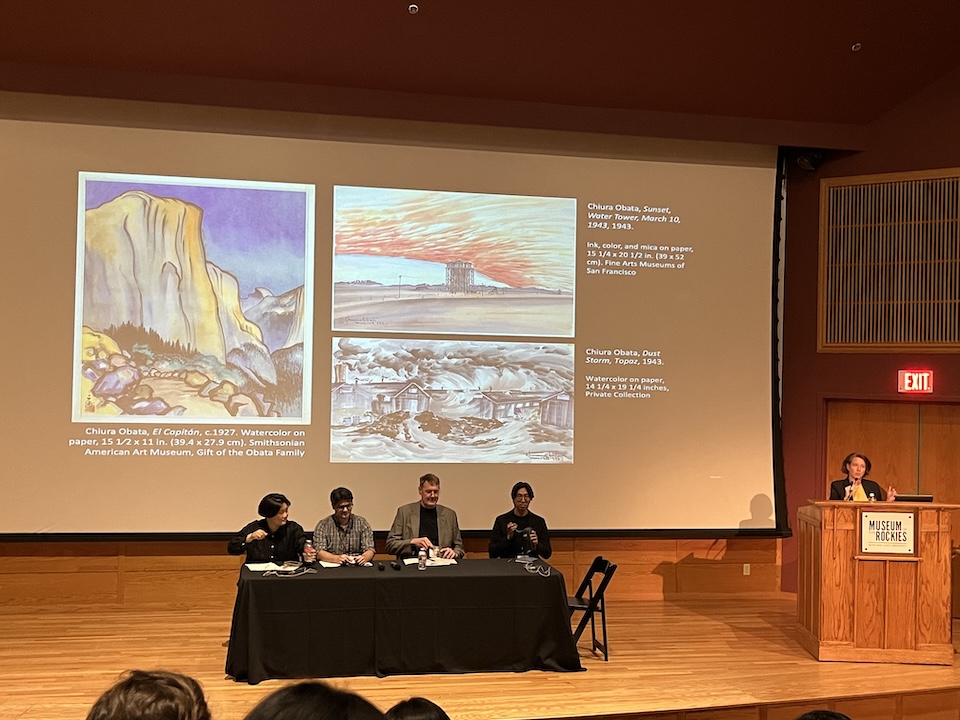
Emily C. Burns, Associate Professor of Art History, University of Oklahoma, fields questions for panelists of Session 5
2:00-5:30 pm
An opportunity for conference participants to linger at the Museum of the Rockies and learn about local history or to explore the historic buildings and parks along Main Street and have lunch
6:00-8:30 pm
Reception for conference participants at the Story Mansion
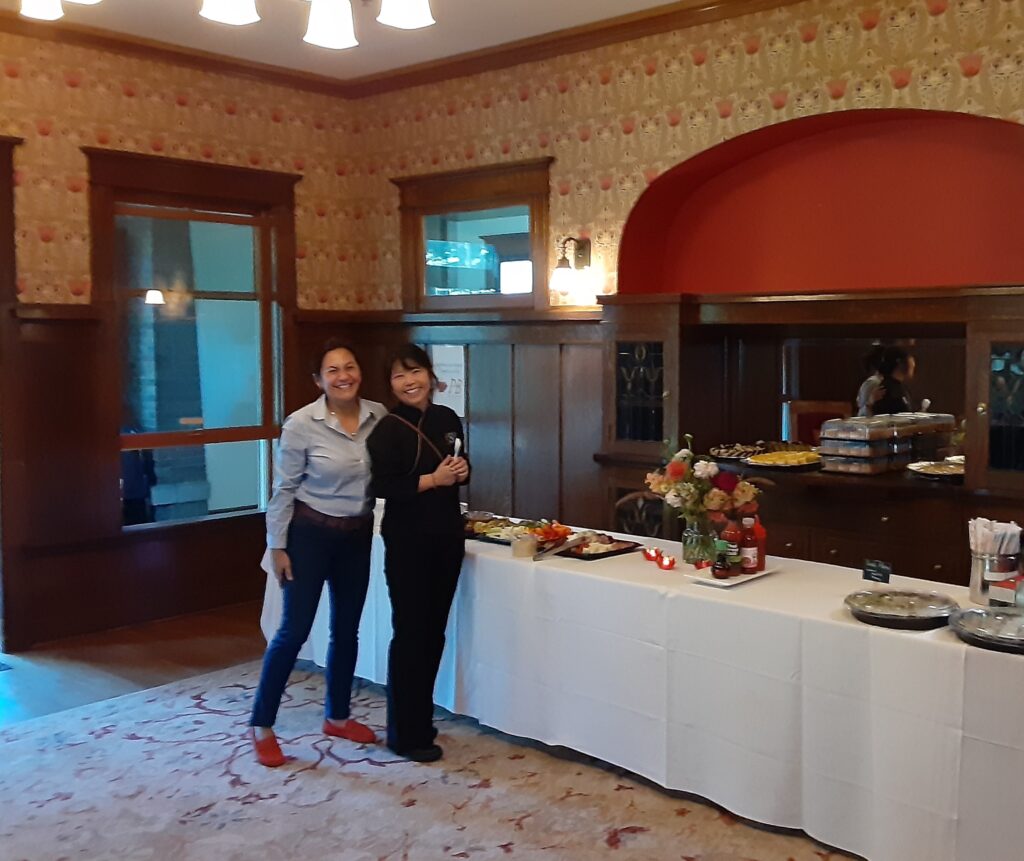
Hua Li, Professor of Chinese Language at Montana State University, with local volunteer Jeleen Briscoe Sindall, organizing the evening reception at the Story Mansion, Bozeman.
Saturday, 28 September 2024
9:30 – 11:00 am
Session 6. Integral Identities, Part 1: Asian Strategies of Self-Representation in the Old West.
Chair: Doris Sung, Assistant Professor of Asian Art, University of Alabama, Tuscaloosa
Doris Sung, University of Alabama, “Research Notes on Gender and Asian-American Artists”
Pat Munday, Montana Technological University, Shihua Chen Brazill, Montana Technological University, Zhang Ke, Sun Yat-sen University, “Chinese American Markers of Modernity: Cheongsam Dresses, Liu Mansions, and Lingnan University”
Hougang (Daffy) Wang, University of Malaya, “Three Chinese Women Artists of the 20th Century: Pan Yuliang, Georgette Chen, and Liu Hung and Issues of Cultural and Gender Identity”
11:15 am – 12:15 pm
Session 7. Integral Identities, Part 2: Asian Strategies of Self-Representation in the Old West.
Chair: William Wei, Professor of History, University of Colorado, Boulder
Mark T. Johnson, Notre Dame University, “Evidence of Oppression, Evidence of Empowerment: Juxtaposing Photographs of Montana’s Chinese Communities, 1892-1906”
Yang Wang, University of Colorado, “Mountains, Mesas, and Babies: Frank Muramoto’s Images of the American West”
12:30 – 2:00 pm
Lunch for conference participants at the Museum of the Rockies downstairs
2:15 – 4:15 pm
Session 8. Past as Prologue: Asian American Artists Today.
Chair: Bert Winther-Tamaki, Professor of Art History and Visual Studies, University of California, Irvine
Kylie Ching, University of California, “Tomie Arai’s Work on the Poston Relocation Center, Arizona”
Zhi Lin, University of Washington, “November 3 on Pacific Avenue in America”
Beth Lo, University of Montana, “Good Children, Mostly: Beth Lo’s Ceramic Renditions of a Chinese-American Life”
Shen Qu, Arizona State University, “Ching Ho Cheng – not your typical Chinese son” This conference is supported by generous grants from the Terra Foundation of American Art, the Paulson-Brown Collection of Asian Art, and the College of Arts & Architecture.
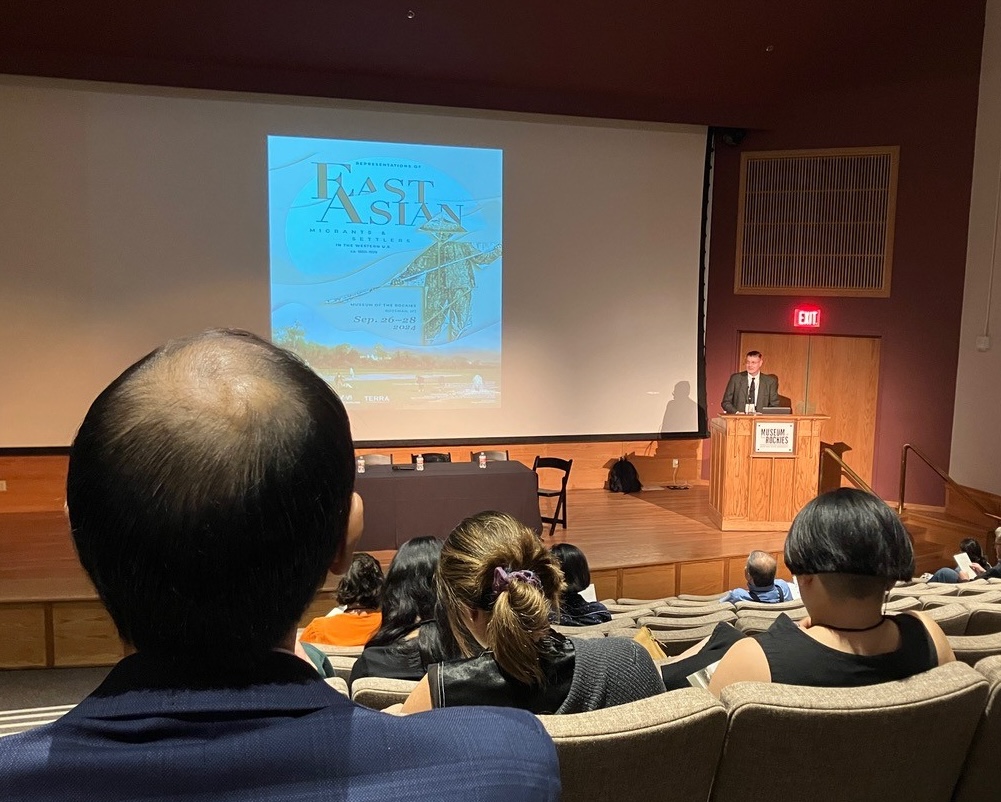
Todd Larkin, Professor of Art History, Montana State University, delivers opening remarks
Opening Remarks
I’m Todd Larkin, Professor of Art History at Montana State University, and I have the great pleasure to introduce the theme of this three-day conference, Representations of East Asian Migrants and Settlers in the Western United States between 1850 and 1929. To put it succinctly, we might say that “representations” refers to artistic depictions or literary portrayals; that “East Asian migrants and settlers” refers to the largely Chinese itinerant workers of the 1850s to 1870s, the Japanese temporary workers of the 1880s to 1910s, and the Asian communities that were born of the necessity of seeking organized protection, planting family roots, and asserting legal rights; that “Western United States” refers not only to West Coast port cities that accommodated passengers arriving on ships from Guangdong Province of southeastern China and Chugoku and Kyushu regions of southwestern Japan but also to Rocky Mountain towns that sprang up to provision those hired to lay rails or to mine gold, silver, and copper.
To a large degree, the terms of our inquiry are motivated by the ambiguities of undertaking research in museums, archives, and libraries. For example, I had the incredible opportunity in the summer of 2021 to trace the manifestation of Daoism, Confucianism and Buddhism in the art and ritual of Asian migrants and setters in the Northern Rockies ca. 1850-1918—a topic that led me to state historical archives at Boise, Butte, Helena, Evanston, and Denver. Every archive betrayed a curious mixture of documentary photographs, newspaper sensationalist journalism, and picturesque book illustrations—which made it a challenge to distinguish, say, a migrant’s expression of community from a colonizer’s stereotype of the “foreign devil.” Where it became especially confusing was when East Asian settlers adopted the dress, customs, and mannerisms of white Americans in a sign of assimilation and European artists continued to pose them in stereotyped occupations, appearance, and attitudes.
My solution was to accept the idea that the American “West”—a nebulous collection of territories whose boundaries were established with utter disregard for indigenous inhabitants and rival nations—nevertheless became a place of convergence for people of various races and cultures in search of a better life, some looking for a steady work, others determined to establish a business or make a home, and still others fighting for equal rights and legal recourse. In so doing, these groups encountered each other and found ways to express their differences—sometimes constructively, sometimes destructively. I see representation as an essential part of a negotiation wherein Asian, American, and European artists and writers portrayed themselves and “the other” according to their own values, which often came with embedded experiences, ideologies, and prejudices. I wondered if a scholarly conference about images might disentangle these perceptual or interpretive threads or affirm the complexity of that tangled skein.
Which brings me to our purpose in gathering here. Comprehensive published histories of Asian art and culture in the American West are a recent phenomenon. What distinguishes our inquiry today from that of previous groups of scholars is a desire to understand how the Asian migrant/settler and American colonizer/European immigrant pouring into the West between the Gold Rush and the Great Depression had something to express or articulate about their encounters with each other and did so in a way that was particular to their cultures and was inevitably stirred or changed in the process. Artists and writers contributed to a rich array of representations of East Asians in different genres—documentary, picturesque, academic, expressive, illustrative, satirical—that promoted a range of views—ethnographic, nationalistic, empathetic, propagandistic, associational, filial, ethnic, gendered.
Over the next few days, this scholarly community will illuminate not only how European-American artists and writers imposed naturalized, stereotyped, racist, and other identities but also how Asian American creative peoples deflected, contested, or rejected such images in the construction of their own identities. As you can see from the program, the conference is comprised of two themes: “Daily Life in the West” and “Contested Claims.” In the first half of the conference, presenters will discuss images of East Asian migrants and settlers in contexts of labor, leisure, worship, and celebration; in the second half of the conference, presenters will discuss representations of Asians in contexts of association, discrimination, and exclusion—yet with a persistent sense of self-affirmation and assertion. In the last session, contemporary Asian American artists will share how they have engaged with, referenced, or distanced the past in their art. What we are doing here is ground-breaking, going beyond the monolithic notion of an “Asian experience” represented by movements in major West Coast cities to embrace a range of diverse historical and creative perspectives of Chinese, Japanese, Korean, and other migrants and settlers who encountered indigenous tribes, European immigrants, and American speculators and officials throughout the West.
Art or cultural history is a discipline that requires intensive study of data as well as tremendous self-awareness to write a credible, critical, and consistent narrative. I think it’s fair to say that humanities professors are as nervous as their students about projects requiring collaboration; this is because they all survived an episode where they had to carry a project through to completion almost single-handedly. I want to acknowledge my collaborator, Professor Hua Li of the Department of Modern Languages at MSU, who patiently read and edited the conference proposal and then rose to every challenge associated with hosting such an event. Thank you for being so knowledgeable, articulate, innovative, and frustratingly imperturbable in the midst of every planning storm. Early in the development of this conference, Carrie Haslett and Amy Gunderson at the Terra Foundation for American Art kindly listened to our ideas and offered important advice to ensure that a project about Asian American and European American visual and textual constructions of “East Asian migrants and settlers” included the major stakeholders. Finally, during the early stages of ideation, we benefitted from the advice of Bruce Robertson, Aleesa Alexander, and Emily Burns.
Thank you.
Select Comments
“Loved your kickoff presentation with the background information and reason why the conference was created and was important.” William Culpepper, Graphic Design, Montana State University
“Thanks for a wonderful panel with rich presentations and discussion that spoke beautifully to each other! I look forward to following your research trajectories!” Emily C. Burns, University of Oklahoma
“Thank you [Todd] and Hua very much for organizing this wonderful event! It was so well organized, and the presentations so amazing! I really felt grateful for having this opportunity to attend it. Hope to see you and other panelists in the near future.” Xiaoquan Raphael Zhang, American University
“Congratulations on such a successful conference; I learned a lot from different academics.” Xiao Ning Shi, York University
“I wanted to take a minute and thank you for organizing the East Asian symposium. It was so fun to get to hear about art, culture and history that took place here in the West that I hadn’t encountered before. The speakers were insightful and engaging and the range of topics made every panel unique and interesting. Thank you for organizing and spending so much time to bring an event like this to MSU. I’ve had the opportunity to attend multiple symposiums while in grad school and this was one of the most enjoyable so far. I especially liked the photography presentations, and getting to talk with the PhD. Candidates from around the country doing work similar to my own interests.” Elizabeth Salacinski, Montana State University
“Well done! What a wonderful treat for Bozeman to have this conference. Congrats!” Carol Mealer, Bozeman